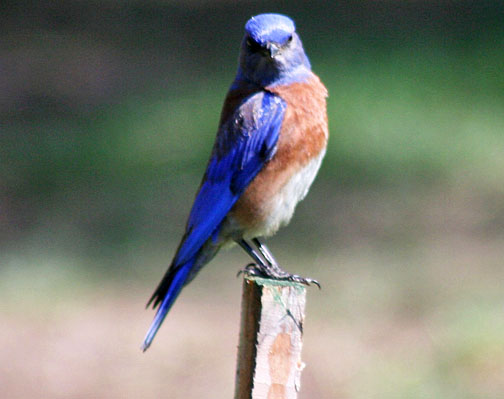
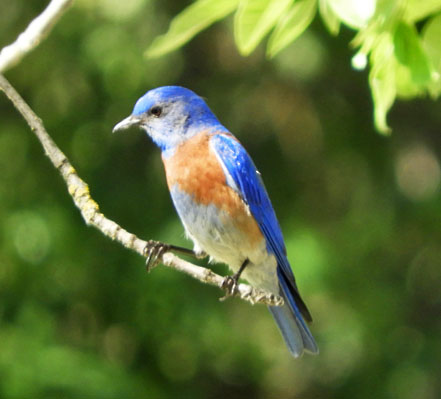
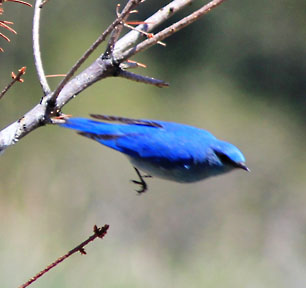
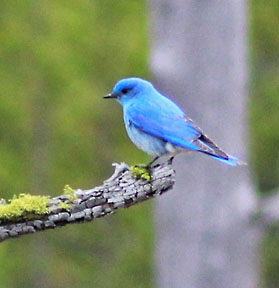
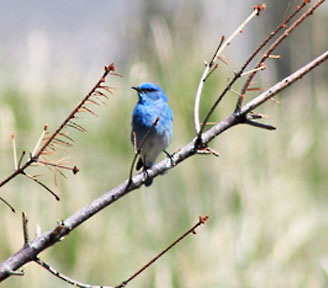
| Bluebirds are members of the thrush family, but that only helps if you are a better and more scientific birder than I am. Both species will be rare if you ever see them in the proposed Monument. Mountain Bluebirds prefer open forests or meadows at the highest elevations, usually over 5,000 feet. Both species nest in cavities in large trees, so both species are suffering from habitat loss. Both species will nest in bird boxes, but there are none of those in the proposed monument. Both species hunt mainly insects, usually across open areas, taking insects, worms, caterpillars in the air or on the ground. The Bluebirds pictured here are all males. There is sexual dimorphism in both species, that is, in the Bluebirds' case, the males are more brightly colored and differently patterned. Females of both species are gray-blue and at first glance may seem more similarly colored, although the female Western Bluebird does share the reddish chest (not as bright) with the male Western Bluebird. Male Bluebirds are easier to see, and easier to identify. The females will tell you that is because the females are doing the work while the males are showing off, but the males will probably respond that there are other reasons. |